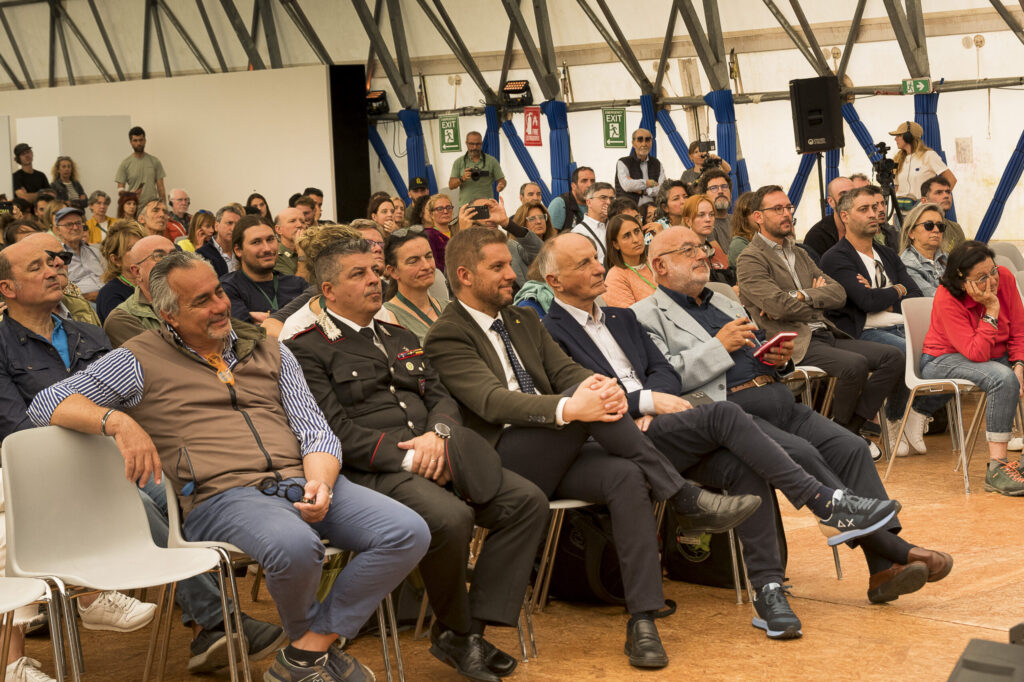

Over 150 people attended the closing event in Pescasseroli of a project that, over the past five years, brought together protected areas, municipalities, associations, businesses, institutions and local communities — both in the Central Apennines and in northern Greece — to lay solid foundations for a future in which humans and bears can coexist peacefully in the long term.
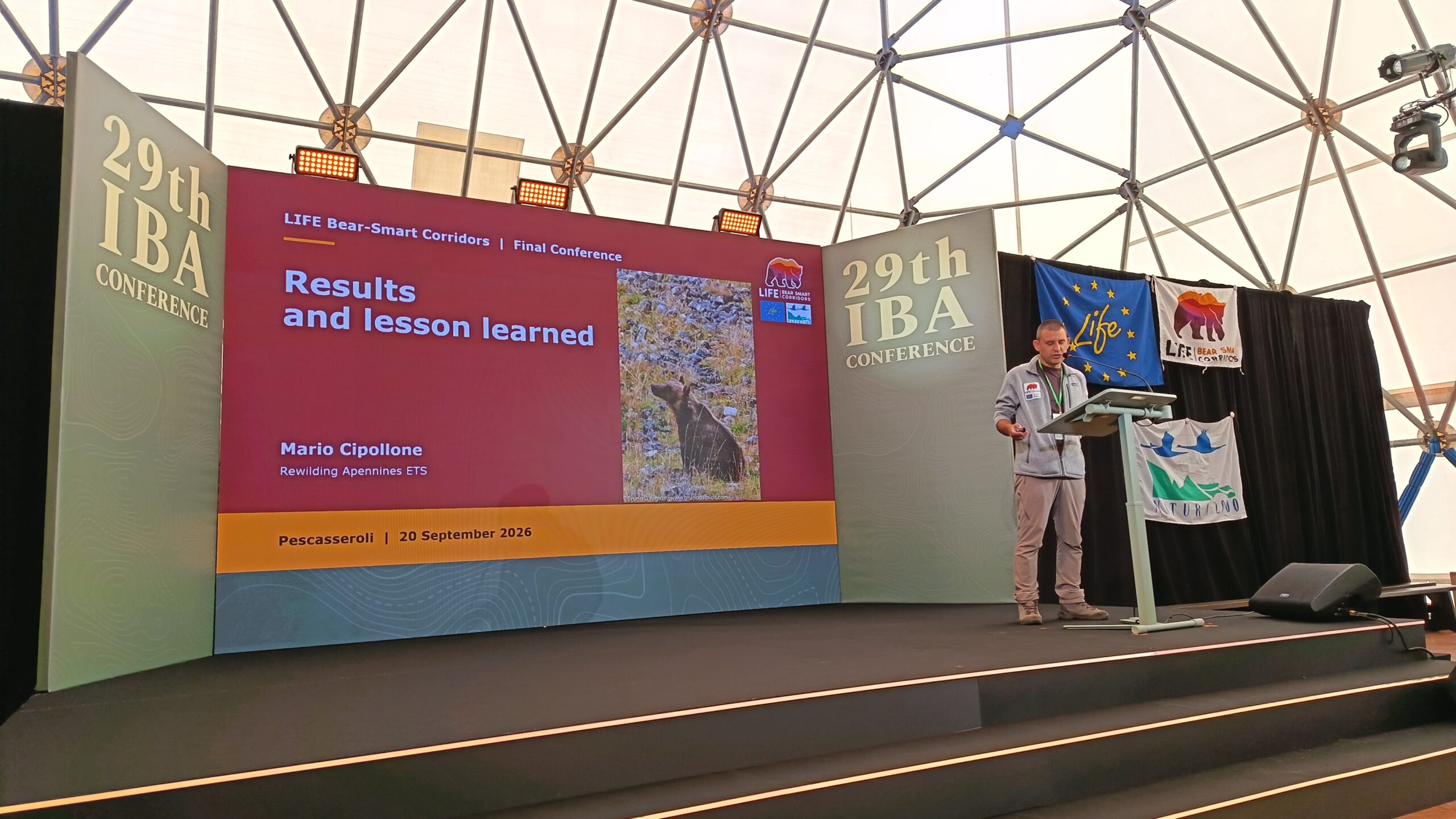
On Sunday 20 September, in Pescasseroli, as part of the prestigious setting of the IBA — International Association for Bear Research and Management — international bear conference, the closing event of the LIFE Bear-Smart Corridors project was held.
It was a morning full of emotion, providing an opportunity to recount five years of work and take stock of a complex journey made up of achievements, difficulties, attempts and collective growth. A LIFE Nature project born to contribute to the conservation of the Marsican brown bear, with the priority of doing so starting from the people who share spaces and territories with the bear every day.
For the first time, bear conservation placed local communities so firmly at the centre, along with their needs, their activities and their expectations. The key word of this initiative — simple to say, far harder to build — has always been coexistence.
The heart of the project was the Bear-Smart Communities and their Committees: people representing diverse economic and social interests who chose to meet in a shared space for dialogue. Not necessarily to eliminate conflict, but first of all to learn how to face it, building over time a shared language and shared responsibility.
Interventions and results
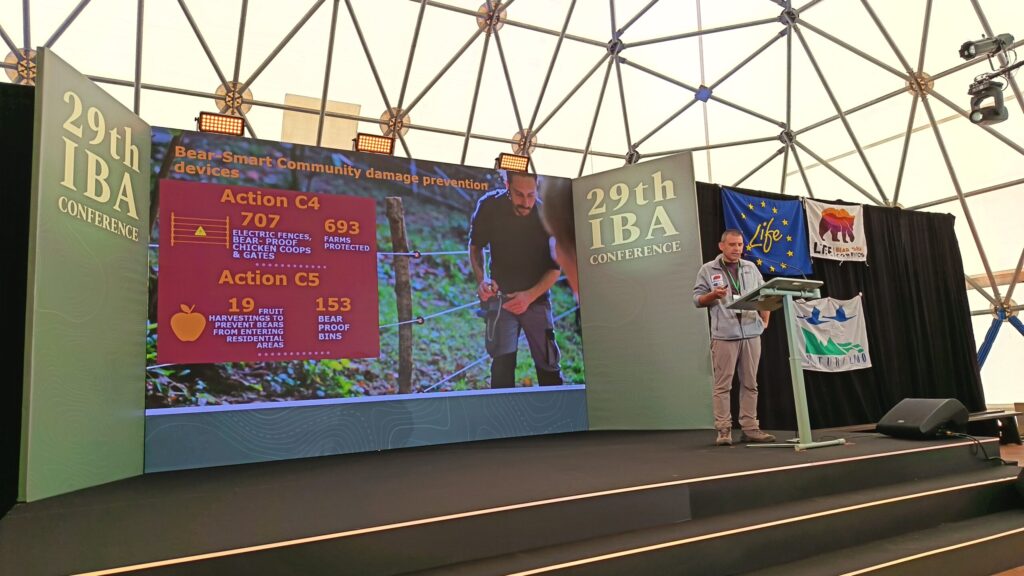
Over five years, 16 Bear-Smart Communities were established in the Central Apennines, and numerous concrete actions were carried out to prevent and mitigate human-bear conflicts: securing 27 water troughs, distributing over 700 damage prevention measures including electric fences, bear-proof chicken coops and gates, installing more than 150 bear-proof waste bins, removing 82,000 metres of abandoned barbed wire from the mountains, conducting 90 rapid interventions (Bear Intervention Unit) to reduce human-bear conflicts, and organising educational activities involving over 1,000 young people and community engagement initiatives, such as the theatrical performance “Wild condominium”. All these figures went well beyond the targets set at the start of the project, as specified by Mario Cipollone, Team Leader of Rewilding Apennines, who presented the actions and results of the LIFE Bear-Smart Corridors project.
Spyros Psaroudas, Director of Callisto, an NGO working in Greece for the protection of the brown bear, likewise presented the project’s results in the Greek area.
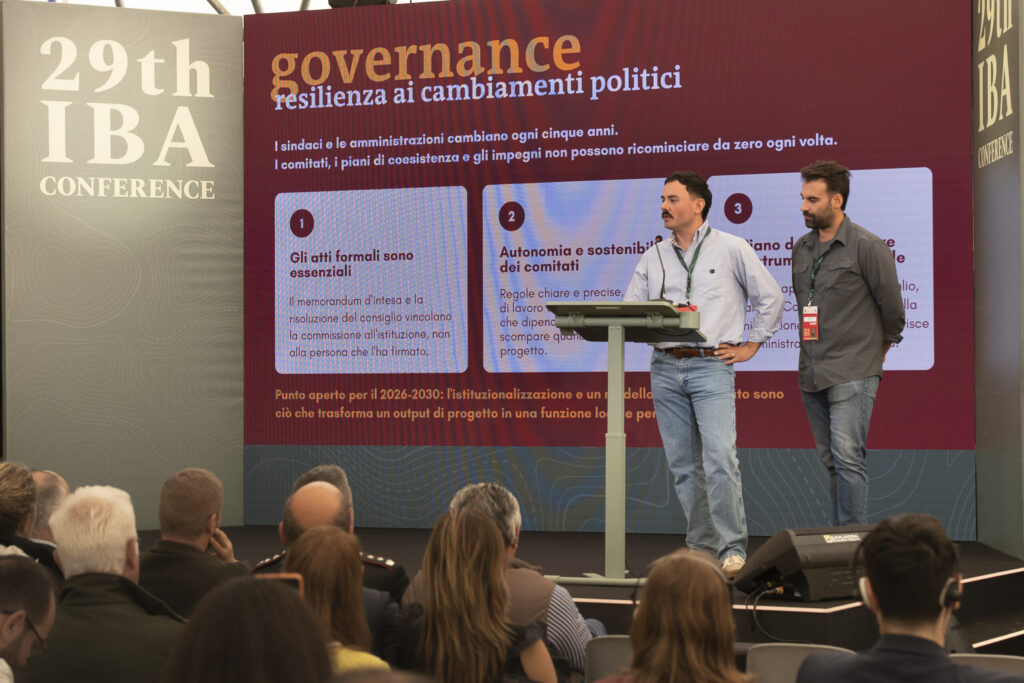
Valerio Reale of Rewilding Apennines and Antonio Di Nunzio of the Abruzzo, Lazio and Molise National Park explored the socioeconomic context of the Apennine Bear-Smart Communities, their governance and the central role of the local committees. They also highlighted how one of the project’s strengths was the ability to build a network among institutions, protected areas, local administrations, the scientific community and associations. Different expertise and approaches were brought to bear on a shared objective, demonstrating how bear conservation and coexistence management require shared responsibility and stable collaboration among diverse actors.
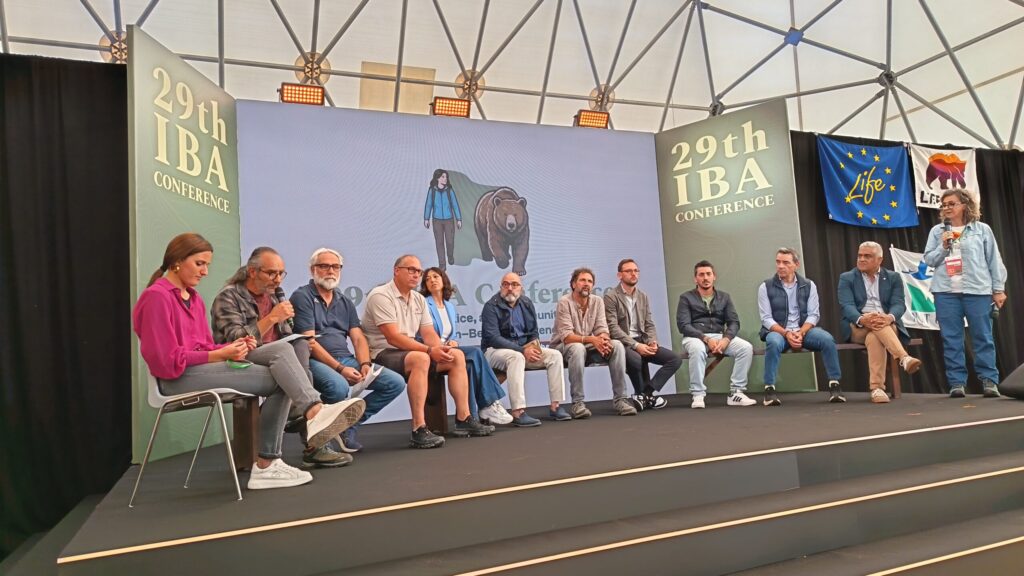
A round table was also held with several representatives of the Bear-Smart Community committees, moderated by Daniela D’Amico of the Abruzzo, Lazio and Molise National Park, to share the diversity of local engagement experiences, the positive aspects, the challenges and the future prospects of human-bear coexistence. The guests recounted how the dialogue allowed them to better understand the needs and critical issues of different groups living in the same village. Sitting at the same table, listening to one another and looking together at their own territory through maps meant beginning to read it in a different and more aware way, with the goal of identifying potential risks of damage or interaction with bears. On stage were representatives from Campoli Appennino (FR), Lecce dei Marsi (AQ), Gioia dei Marsi (AQ), Morino (AQ), Ortona dei Marsi (AQ), Pettorano sul Gizio (AQ), Pizzone (IS), Scanno (AQ), Vastogirardi (IS) and Villetta Barrea (AQ).
Two further panel discussions with stakeholders followed. The first, coordinated by Luciano Sammarone, Director of the Abruzzo, Lazio and Molise National Park, and Valerio Reale, Enterprise Manager of Rewilding Apennines, focused on the future of the Marsican bear, in search of a balance between range expansion and economic sustainability. The second, moderated by Valeria Barbi, environmental journalist and communications officer of Salviamo l’Orso, addressed bear conservation policies.
International recognition and lasting relationships
The Bear-Smart Communities experience and the work carried out with the Committees were also presented during the second day of the IBA conference on Tuesday 22 September, where the approach received very positive feedback, above all for having placed local communities at the centre of coexistence processes and made them an integral part of conservation strategies.
An important step for the future will be the formal recognition of Bear-Smart Communities by institutions, so that the model developed over these years can become firmly embedded in land management and conservation policies, with the tools, responsibilities and resources needed to ensure its continuity over time.
Thanks go to all the people who worked on the project over these five years, contributing their expertise, time, passion and willingness to engage in dialogue: partners, institutions, associations, administrations, technical staff, volunteers and, above all, the community members who chose to get involved.
The conclusion of LIFE Bear-Smart Corridors does not, however, mark the end of the journey. The project is closing, but what remains are the relationships built, the skills acquired, the tools developed and, above all, the communities’ enhanced capacity to face future challenges together.
In the years ahead, it will be important to keep alive what has been built and, where possible, to replicate the Bear-Smart Community model in new territories interested by the bear’s range expansion, because the future of the Marsican bear and that of the communities of the Central Apennines are built together.
LIFE Bear-Smart Corridors is ending. The journey of the Bear-Smart Communities, however, has only just begun.