Rights of Nature: enabling citizens to represent and protect ecosystems
.
RIGHTS FOR NATURE – EUROPEAN CITIZENS’ INITIATIVE: Sign here
FOR THE RIGHTS OF THE BEECH FORESTS OF THE SIMBRUINI MOUNTAINS: Sign here too
Why this initiative?
People, children, even companies are all legal subjects. Those who cannot defend their own rights in court can do so through a guardian who represents them. Why should an ecosystem, or a species threatened by misguided human actions, not be able to do the same?
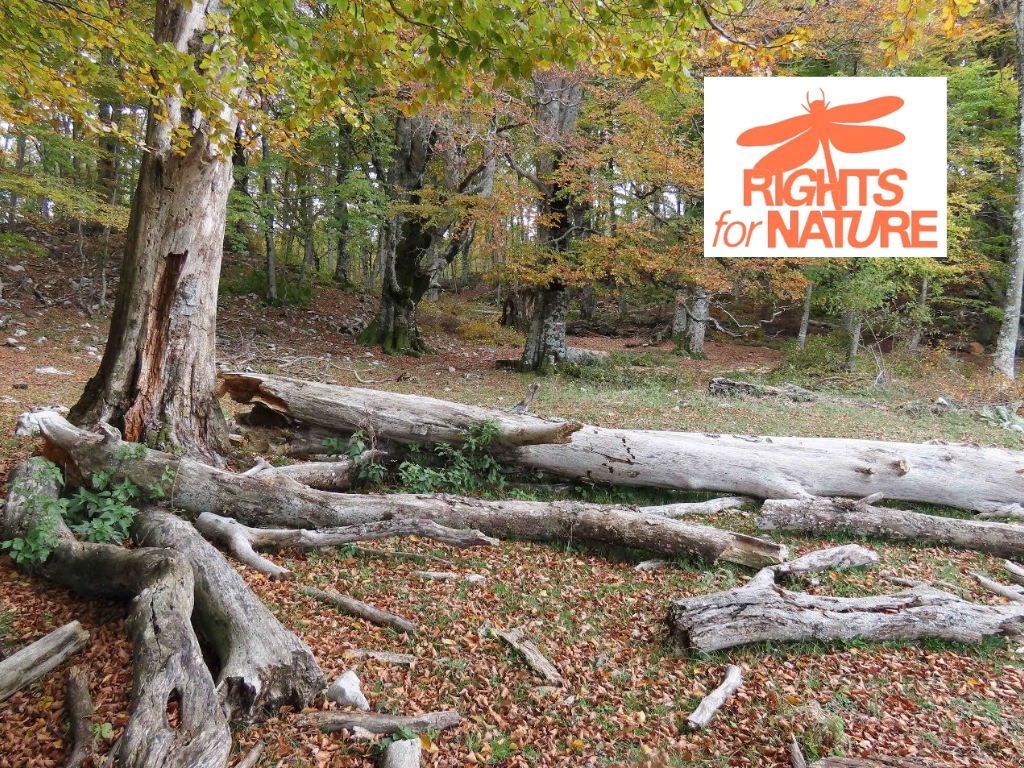
The beech forest ecosystem of the Simbruini Mountains, covering more than 70,000 hectares across Abruzzo and Lazio, is one of the most vital and important in the entire Apennines. Yet it is threatened by unsustainable and inappropriate forest exploitation, which undermines the conservation status of its ecological functions and of all the valuable species that make it up (bears, wolves, birds, plants, fungi and much more).
We want concerned citizens to be able to represent and defend the Simbruini beech forests, including in court.
For this reason, all of us, citizens of good will, committees and associations working to defend Nature, call for the Rights of Nature to be recognised at national and European Union level, by supporting the European Citizens’ Initiative on the Rights of Nature and by securing representation for the Simbruini beech forest ecosystem in all institutional and judicial settings.
The Simbruini beech forests are a priority habitat protected at European level
The beech forest ecosystem of the Simbruini Mountains is protected at European level under the EU Habitats Directive as priority habitat 9210* “Apennine beech forests with Taxus and Ilex”. It is a priority habitat because, in the whole of Europe, it occurs only in Italy and only in the Apennines.
The beech forest ecosystem is made up of trees, shrubs, herbaceous plants, small and large animals, fungi, leaf litter, decaying wood, humus and the countless functional relationships between all these organisms, each of which is an essential building block of the whole structure.
The habitat covers around 200,000 hectares, almost half of which lies in the Simbruini, making them the most important area in Europe for its protection.
Its conservation status is assessed as ranging from favourable to inadequate depending on the area, but a decline is foreseeable unless the way its substantial timber resources are exploited changes.
But is this important ecosystem really protected?
- Two large Special Protection Areas and numerous Special Areas of Conservation within the European Union’s Natura 2000 network formally protect the 70,000 hectares of Simbruini beech forest, but without any real management aimed at protecting nature.
- Only on the Lazio side is there a large Regional Nature Park, the Monti Simbruini Regional Nature Park, covering around 30,000 hectares (and acting as the managing body for the 50,000-hectare SPA). On the Abruzzo side there is only a tiny Regional Nature Reserve, Zompo lo Schioppo (managed by the Municipality of Morino), of barely 1,000 hectares, which is the managing body for the vast SPA of almost 20,000 hectares.
- Any intervention in this vast area must first undergo the mandatory Appropriate Assessment procedure. This procedure, however, is systematically circumvented: through insufficient investigations and studies with no public participation (Lazio), or through incomplete studies that do not comply with national and European legislation (Abruzzo), as extensively documented in a dossier prepared by Stazione Ornitologica Abruzzese, LIPU and Forum Ambientalista.
Why a European initiative?
Europe faces intertwined ecological, social and democratic challenges. Biodiversity loss, a changing climate and ecosystem degradation threaten the very foundations of life and compromise the wellbeing of people today and of future generations. Yet current environmental legislation regulates human activities that affect nature while continuing to treat ecosystems as property that can be owned, traded and destroyed, provided the paperwork is in order. Companies that profit from exploiting nature have rights, while the forests they degrade have none. In this context, citizens who live in close contact and relationship with ecosystems are largely excluded from the decisions that concern them. This approach of top-down restrictions, without genuine participation and public debate, fuels a distrust of democratic institutions that environmental policy cannot afford, and at the same time limits the prevention, restoration and effective protection of ecosystems themselves.
The Rights of Nature movement works to tackle the problem at its root, proposing a new vision of the relationship between human beings and the natural world, grounded in the understanding that nature is not property or a resource, but a living community with intrinsic values and rights, of which we ourselves are part. In recent years, civil society organisations in several European countries have been promoting this recognition as a transformative legal, cultural and democratic approach, capable not only of strengthening the protection of nature through the recognition of its legal personhood, but also of empowering citizens and involving them in its protection. Building on historical precedents such as Spain’s Mar Menor lagoon, and on a growing body of national and international Rights of Nature legislation, this Initiative represents a historic opportunity to place ecosystems, and those who protect them, at the heart of European legislation.
The European Citizens’ Initiative (ECI) “Rights of Nature: enabling citizens to represent and protect ecosystems” (https://www.rightsfornature.eu/) seeks recognition of the Rights of Nature in Europe through an ECI, the only direct democratic participation mechanism that allows citizens to put forward a legislative proposal to the European Parliament. The initiative aims to strengthen the protection of habitats and species protected at European level, most of which are currently in an inadequate or bad conservation status, and is promoted by 22 organisations from 16 European countries, including Italy. With one million verified signatures collected within 12 months from at least seven Member States, the European Commission will be legally required to respond by proposing the adoption of an EU Directive or Regulation providing for three measures:
- recognising the legal personhood of ecosystems, with their right to exist, to regenerate their life cycles and to be restored;
- empowering citizens and communities to act as their legal representatives, in a spirit of guardianship rather than ownership;
- creating an integrated legal architecture that fills the structural gaps left by today’s fragmented legislation, with a framework based on the rights of nature.
Signature collection opened on 13 October 2026 and, less than a month later, more than 70,000 signatures had already been gathered across all twenty-seven EU Member States (over 2,000 in Italy alone).
Recognising the rights of an ecosystem is possible: the case of the Mar Menor lagoon in Spain
The Mar Menor lagoon (Murcia, Spain) was the first ecosystem in Europe to be granted legal personhood, through the adoption of Law 19/2022, promoted by a Popular Legislative Initiative led by the jurist Teresa Vicente Giménez, which collected more than 640,000 signatures.
The law grants the Mar Menor lagoon and its basin the right to exist, to evolve, and to be protected, conserved and restored. Any citizen, non-governmental organisation or local authority can take legal action on behalf of the ecosystem to stop abuse or pollution (such as the run-off from intensive agriculture that had caused severe eutrophication crises and fish die-offs since 2016).
In November 2024, the Spanish Constitutional Court (ruling no. 142/2024) upheld the validity of the law, describing it as a form of “moderate ecocentrism”.
The management and protection of the lagoon are entrusted to dedicated bodies (including a Committee of Representatives, a Monitoring Commission and a Scientific Committee), and in 2025 the ecosystem was even given its own tax identification number and bank account.
Recognising the rights of a threatened species is possible: the case of the bear Amarena in Abruzzo
During 2025 and 2026, several environmental and animal welfare organisations put themselves forward as “guardians” of the interests of the Marsican brown bear and of the entire Apennine ecosystem in the criminal proceedings for the killing of the bear Amarena. They did so pending the Italian legal system granting the species the subjective rights it deserves, following the first step taken in 2022, when the protection of the environment, biodiversity and ecosystems was added to the fundamental principles of the Italian Constitution. The Constitutional Court has repeatedly defined these as “public interests of primary and absolute constitutional value”.
At the most recent hearing, held on 5 June 2026 at the Criminal Court of Avezzano (L’Aquila), twenty-five parties (including Appennino Ecosistema and Salviamo l’Orso) were formally admitted as civil parties and will therefore be able to represent the Marsican brown bear in court, seeking a fair conviction of the person responsible for the killing and corresponding compensation, which will be used to fund protection and conservation work for the species.
What can we do now?
- Sign and share the petition “Le faggete dei Simbruini: un ecosistema con diritti e personalità giuridica” (The Simbruini beech forests: an ecosystem with rights and legal personhood): https://www.change.org/Diritti_delle_faggete_dei_Simbruini;
- Sign and share the European Citizens’ Initiative on the Rights of Nature, either directly with a digital identity (SPID in Italy) or by providing the details of an identity document: https://citizens-initiative.europa.eu/initiatives/details/2026/000006_en;
- Put pressure on the Regional Administrations of Abruzzo and Lazio, on the Monti Simbruini Regional Park authority and on the relevant Municipal Administrations, so that every forestry intervention is discussed with citizens in advance (through public consultation) and undergoes the required Appropriate Assessment, carried out seriously and thoroughly and with public participation;
- Keep watch over ongoing works in the beech forests, to ensure they are carried out without causing significant damage to the ecosystem, and report any unjustified harm to the ecosystem.