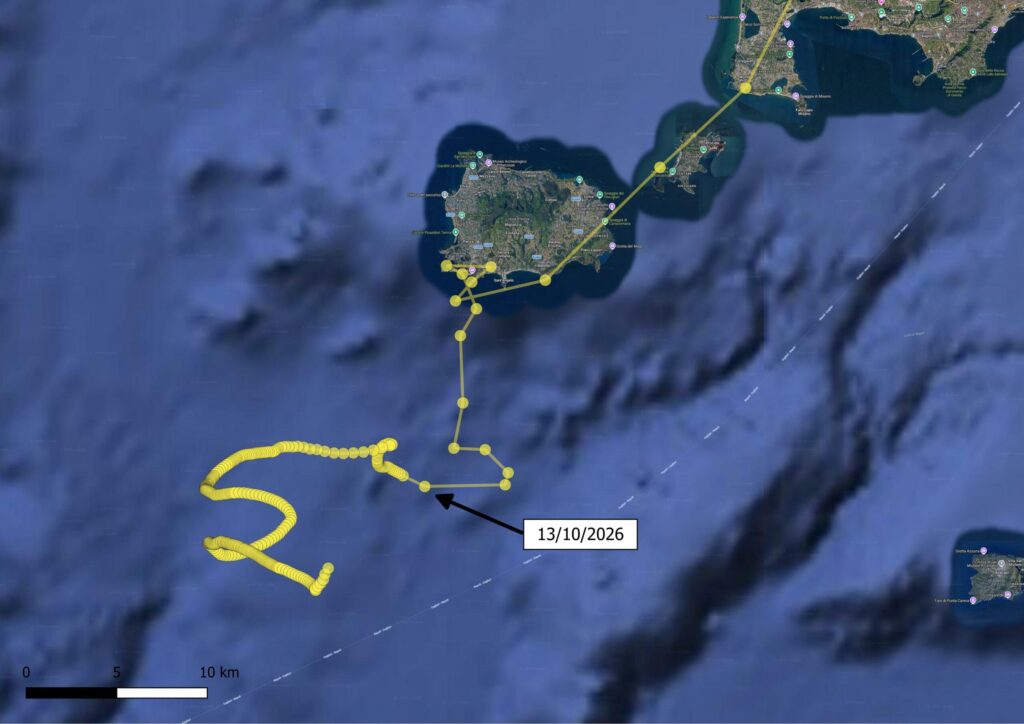
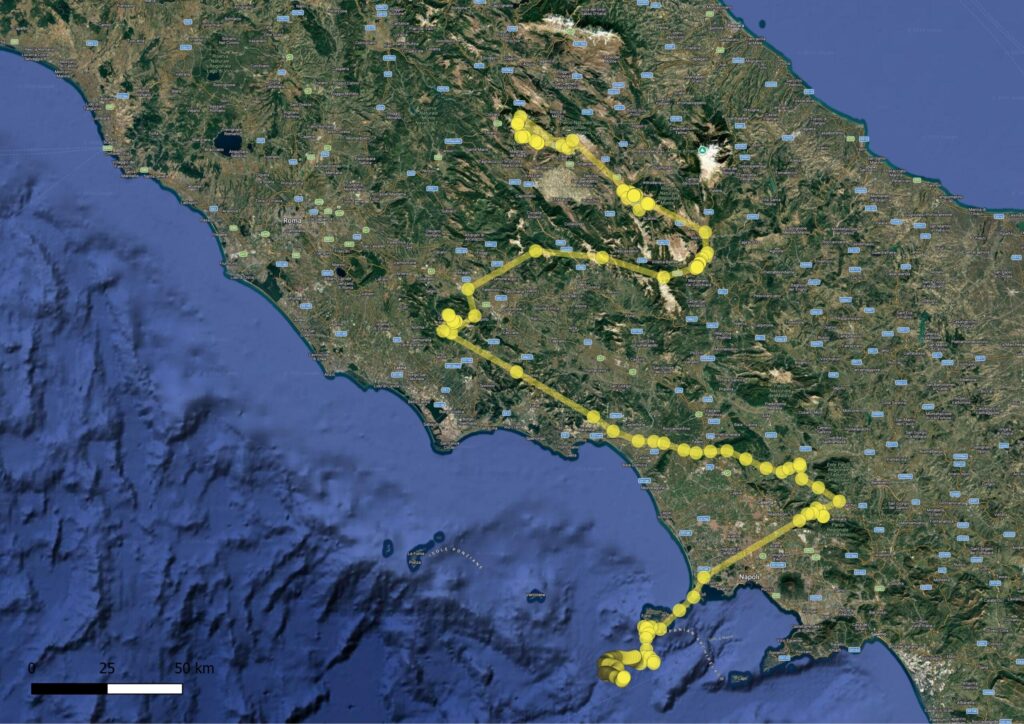
The young individual, monitored with GPS as part of Rewilding Apennines’ species monitoring and conservation activities, followed an unprecedented route towards the Gulf of Naples. After days of anomalous offshore locations, a joint mobilisation of scientists, institutions and local fishermen recovered its lifeless body.
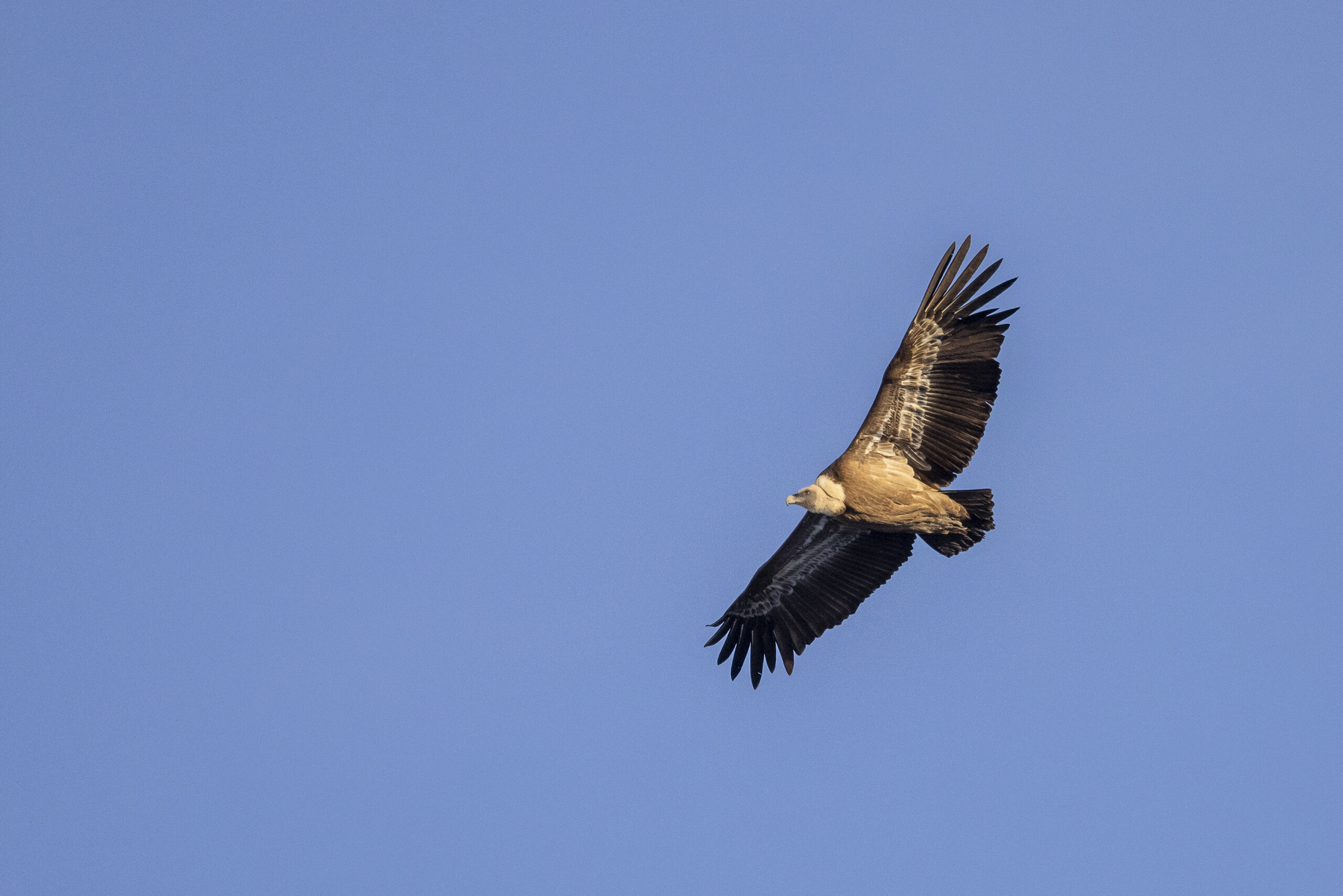
For the first time in recent ornithological history, a griffon vulture (Gyps fulvus) has reached the island of Ischia. This is not a record based on chance sightings or opportunistic photographs, but the trace left by a special individual: a male of approximately two and a half years of age, not yet sexually mature, equipped with a satellite GPS transmitter to track its movements.
The griffon vulture’s presence in Italy represents one of conservation’s great successes: extinct across much of the peninsula, the vulture returned to nest in the Central Apennines in the late 1990s thanks to a far-sighted reintroduction programme launched by what was then the State Forestry Corps (today managed by the Carabinieri Biodiversity Unit of Castel di Sangro), which enabled the formation of breeding colonies in a population now estimated at over 300 individuals and 60 nesting pairs.
The griffon that reached the island is one of 25 Spanish individuals released in the Central Apennines in September 2026. These vultures are part of a population reinforcement project running over three years, with a total of approximately 60 individuals planned for release.
The project represents an international collaboration between Rewilding Apennines, the Carabinieri Biodiversity Unit of Castel di Sangro, GREFA (Grupo de Rehabilitación de la Fauna Autóctona y su Hábitat) and Rewilding Europe, with the aim of stabilising the Apennine population and reducing its long-term vulnerability. All released individuals are fitted with satellite GPS transmitters, enabling their movements to be tracked and allowing for intervention in cases of poisoning or poaching.
The vultures spent a seven-month period in an acclimatisation aviary, allowing them to become familiar with the surrounding environment and to interact with wild conspecifics. This period is designed to strengthen the griffons’ bond with the territory, reducing the likelihood of dispersal after release. The process worked effectively, and almost all individuals remained in the Central Apennines, associating with wild griffons and feeding alongside them. As often happens in such cases, however, some young griffons undertook long dispersal movements, reaching as far as Albania.
On 13 October, however, telemetric data signalled a wholly unusual trajectory, leading the young vulture to fly over the island of Ischia. The evolution of the track immediately raised suspicion among ornithologists: from 14 October onwards, the GPS recorded speeds and altitudes consistent with a fall into the sea.
The mobilisation and the search at sea
From that moment, a complex race against time began. The Carabinieri Biodiversity Unit and Giulia Pace (Rewilding Apennines) activated contacts in the area to attempt a rescue at sea. However, the considerable distance from the coast and prohibitive maritime weather conditions rendered all attempts at reconnaissance futile in the first few days.
The operational breakthrough came on Sunday 18 October: ornithologist Rosario Balestrieri (Stazione Zoologica Anton Dohrn) coordinated a virtuous network of field cooperation, liaising with the Deputy Mayor of Forio d’Ischia, Angela Albano. From Forio, the vessel Sea Dream Ischia, skippered by Raffaele Iacono, set out with Balestrieri himself and wildlife photographer Michelangelo Ambrosini on board.
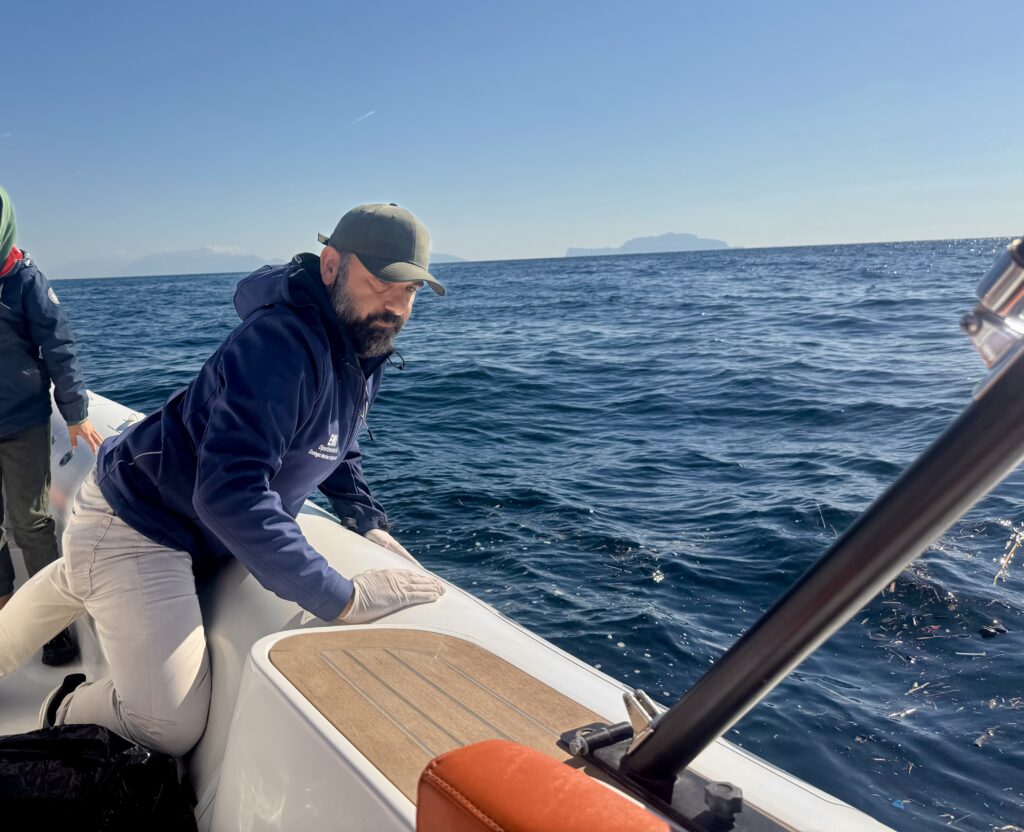
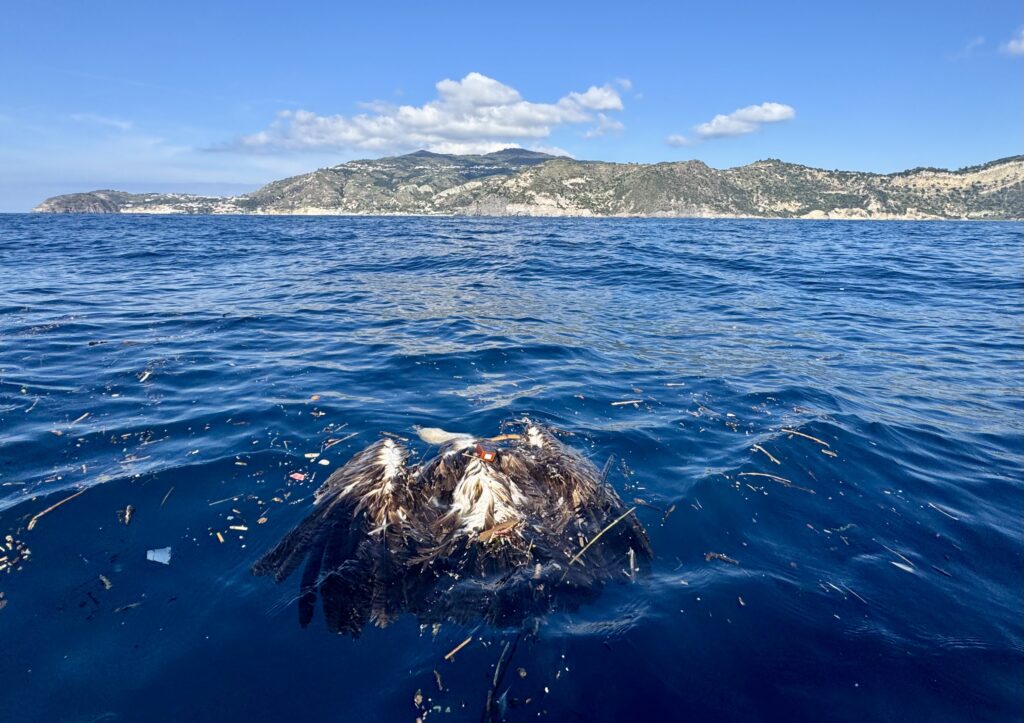
Guided by satellite coordinates updated every ten minutes by the Carabinieri Biodiversity Unit and Giulia Pace, and scanning the water’s surface with professional optics, the rescuers located the animal at around 11:30. The griffon, symbolically renamed “GyPS” by those searching for it, merging the taxonomic genus and the satellite signal that traced its fate, was floating lifeless on the water.
The raptor’s body was recovered and brought to the port of Ischia. In accordance with the protocol for protected wildlife, the CRAS (Wild Animal Recovery Centre) of the Federico II University at ASL Napoli 1 Centro had been alerted in advance; it liaised with ASL Napoli 2 Nord, which took charge of the carcass for subsequent transfer to the Istituto Zooprofilattico Sperimentale del Mezzogiorno (IZSM). Necropsy and toxicological examinations will clarify the exact cause of death.
Nicolò Borgianni, Vulture Field Officer, Rewilding Apennines, commented: “Erratic and long-range dispersal movements are a typical and ecologically fundamental behaviour in griffon vultures before they reach sexual maturity, allowing them to explore new territories and maintain gene flow between populations, but exposing individuals to considerable risks and high mortality rates. Griffon vultures are specialists in passive flight and are capable of covering very long distances without barely beating their wings, exploiting thermals and wind currents — conditions that fail over large expanses of water, making sea crossings particularly hazardous, especially for an inexperienced young griffon. Episodes such as this one, however painful in their outcome, demonstrate the crucial importance of GPS monitoring for a thorough understanding of the routes, threats and ecological corridors of these great soarers, so that conservation strategies can become ever more targeted and effective.”
Rosario Balestrieri, Ornithologist at the Stazione Zoologica Anton Dohrn, added: “When at dawn on Sunday I was racing to catch the ferry to Ischia, I knew the chances of finding it alive were slim, and even during the search at sea the hope of spotting any sign of life was virtually nil. I threw myself into this mission nonetheless, because I firmly believe that in the protection of biodiversity and threatened species, timidity must be set aside and action taken with absolute conviction: not trying means removing all hope from the outset. We now await the autopsy results with apprehension. I hope with all my heart that it was not an act of poaching or a gunshot that condemned this extraordinary animal: it would be unacceptable to think that one person’s ignorance or cruelty could undo the collective efforts of all those who work every day to protect nature and save threatened species.”