
A study co-authored by Rewilding Apennines and just published in Hystrix shows that the ecological corridors designed for the Marsican brown bear host high densities of eight other mammal species. Camera-trap monitoring opens a new perspective on the management of these areas.
..
…
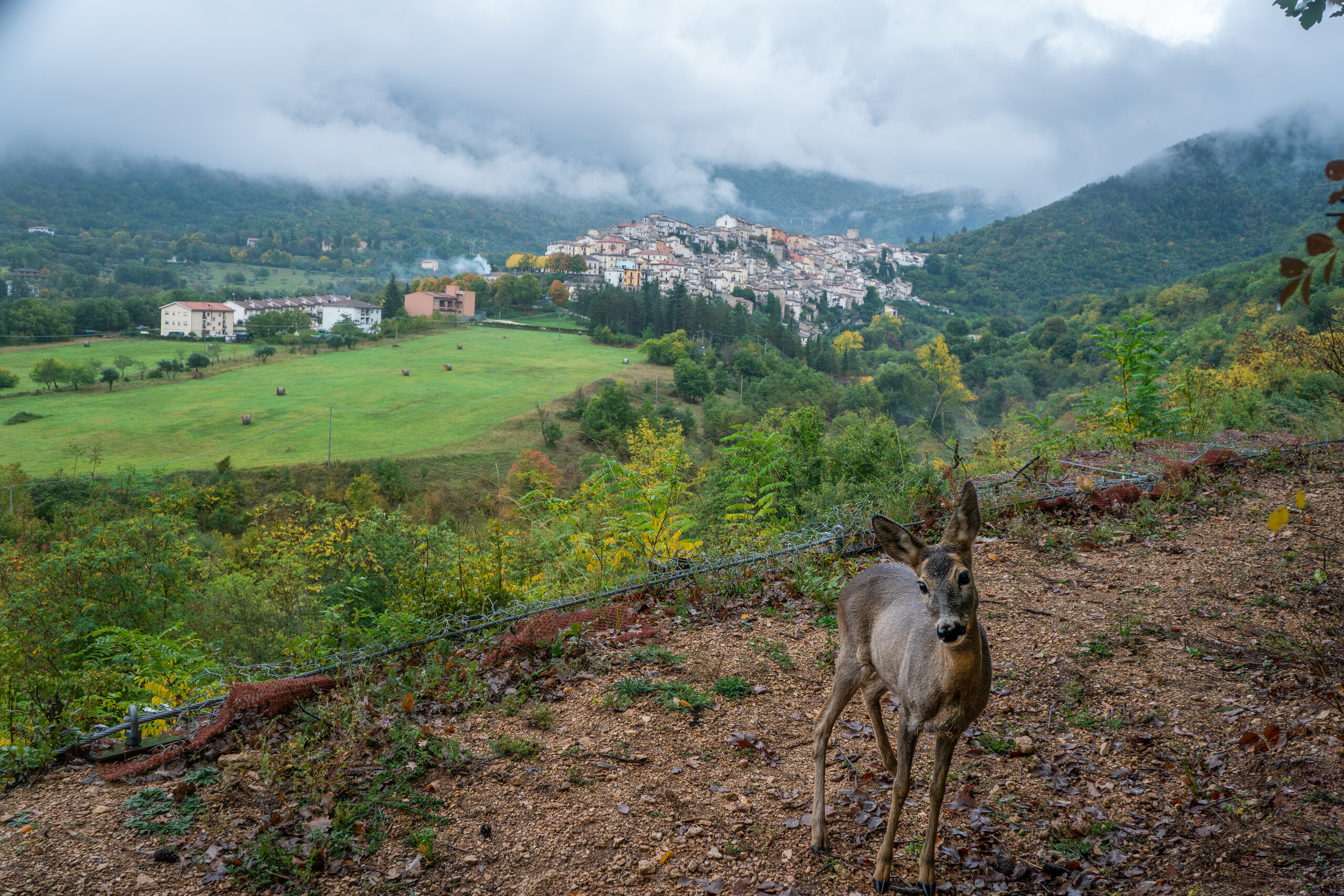
Thirty-four camera traps, 215 days of sampling, two ecological corridors in the Central Apennines. The results, just published in Hystrix, the Italian Journal of Mammalogy, reveal something long suspected but now measured: the areas where Rewilding Apennines works to facilitate the movements of the Marsican brown bear also serve many other animals.
The study is the product of a collaboration between Sapienza University of Rome, Rewilding Apennines and IIASA (International Institute for Applied Systems Analysis). Mario Cipollone and Jan-Niklas Trei of Rewilding Apennines are among the authors, and fieldwork was made possible by the organisation’s team and the volunteers of the 2023 summer season. It is the kind of research Rewilding Apennines has been carrying out for years in the corridors: systematic monitoring, data collection, and partnership with the academic world.
The study, led by Chiara Dragonetti of Sapienza University of Rome, estimated the population density of eight meso- and macro-mammal species: badger, hare, crested porcupine, red deer, red fox, roe deer, wild boar and wildcat. The study area covers the corridors connecting the Abruzzo, Lazio and Molise National Park to the Sirente Velino Regional Park (Corridor 1) and the Majella National Park (Corridor 2), totalling approximately 265 km². These are two of the five corridors identified under PATOM (the National Action Plan for the Conservation of the Marsican Brown Bear) and are at the heart of the rewilding, restoration and mortality-reduction work that Rewilding Apennines conducts in these areas, including through the LIFE Bear-Smart Corridors initiative.
A
Wildlife densities: corridors hold their own
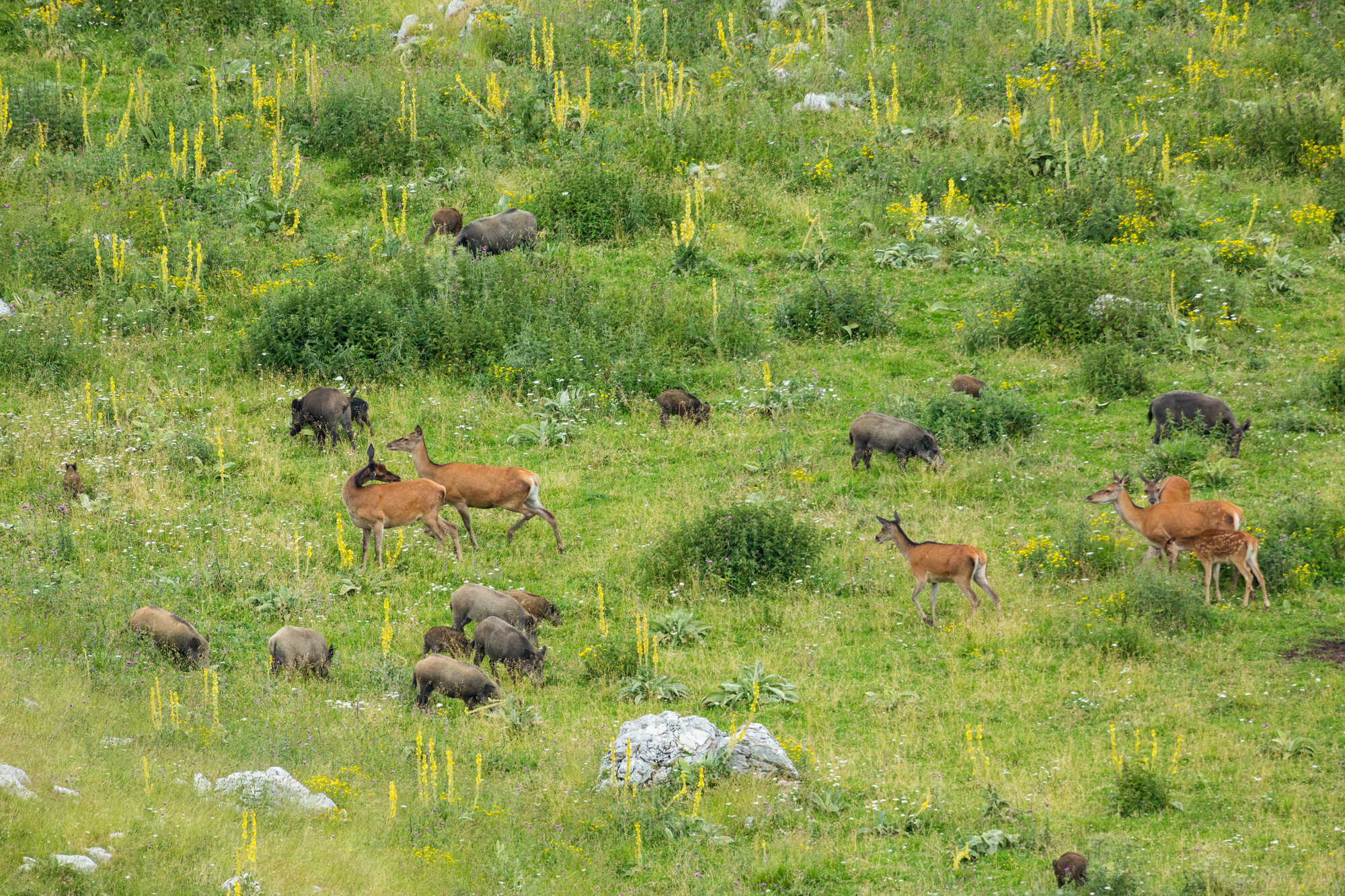
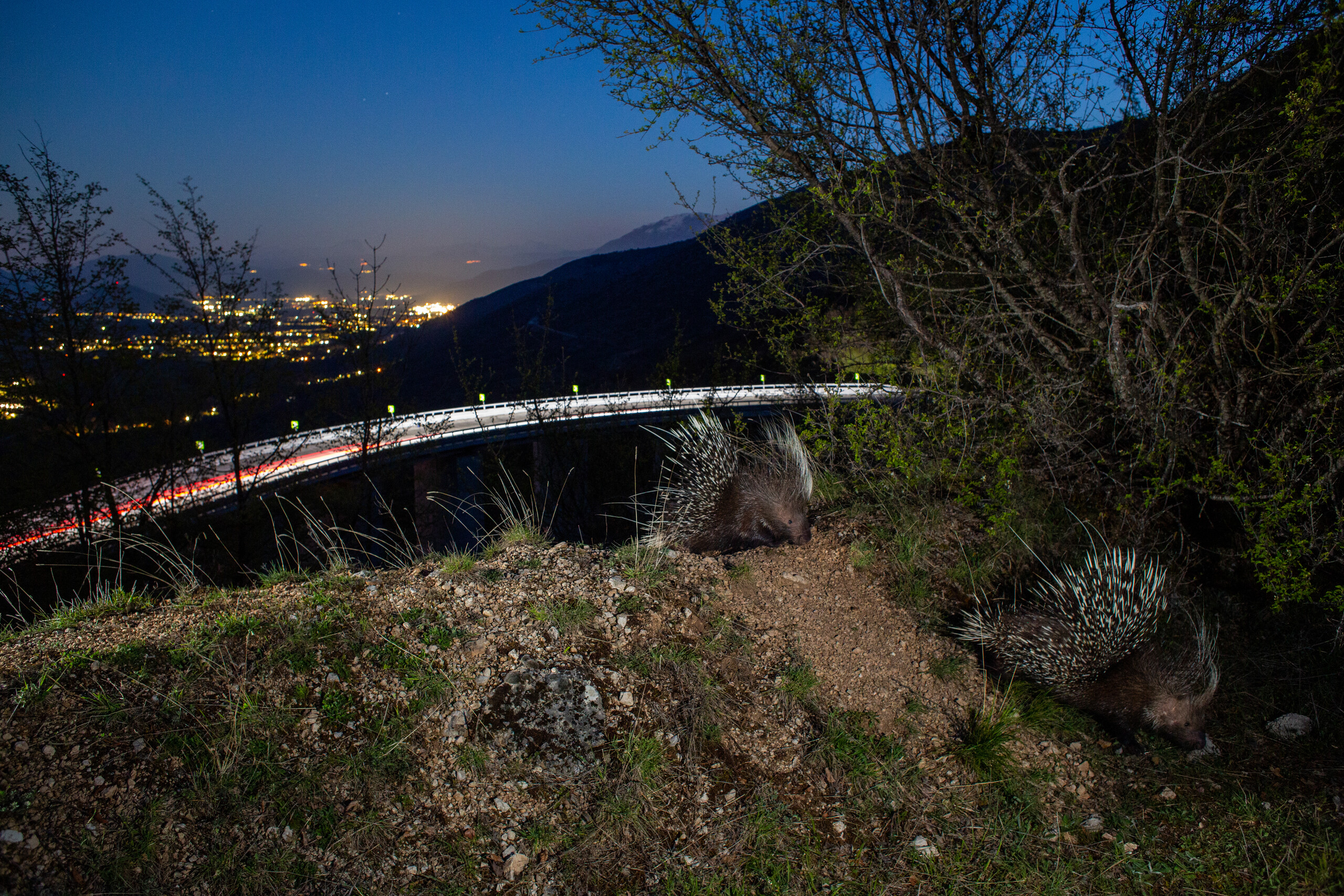
The numbers are clear. Wild boar recorded the highest density (7.22 individuals/km²), followed by roe deer (3.41) and hare (3.39). But the most significant finding lies elsewhere: for nearly all species, the densities estimated in the corridors match or exceed those reported in the literature for other European areas. Red deer, for instance, reach 3.16 individuals/km², a value very close to the estimate from within the Abruzzo, Lazio and Molise National Park obtained with different methods (3.8 ind/km²). The crested porcupine, at 1.40 individuals/km², surpasses estimates available for other Italian regions, likely because the study area falls within the core of its range.
…
Two corridors, two different stories
The comparison between the two corridors reveals marked differences. Corridor 1, lower in altitude, more fragmented, with a proportion of extensive agriculture, shows higher densities for nearly all species. Wild boar there reach 14.21 ind/km² compared to 1.69 in Corridor 2. Badger, red fox and roe deer follow the same pattern. The only exception is the hare, with broadly similar values in both areas.
Corridor 2, dominated by woodland and at higher elevations, appears instead to favour the wildcat, which shows higher trapping rates there, although data are insufficient for a separate density estimate.
An interesting finding for management: Corridor 1, with its landscape shaped by traditional, non-intensive human activity, proves to be a rich habitat. It confirms what Rewilding Apennines advocates through its work on the ground: extensive farming and traditional grazing can coexist with high densities of wild fauna.
A
The umbrella effect
The central point of the study is clear: corridors designed for the Marsican bear do not serve the bear alone. They function as high-quality habitat for an entire mammal community. This is what ecologists call the umbrella effect: protecting a species with large spatial requirements creates favourable conditions for species with smaller ones.
For Rewilding Apennines, the study represents a baseline: a starting point from which to measure, over the years, the effects of ongoing management and rewilding actions in the corridors.
It is the kind of result that lends scientific weight to everyday fieldwork. And that demonstrates, with data, that investing in ecological connectivity yields benefits well beyond the single species for which those corridors were designed. Effective management of these corridors, with a focus on reducing human disturbance, strengthening coexistence and damage prevention, and improving habitat connectivity, will be critical for the long-term survival of the Marsican bear and the species sharing its range.
_______
Read the full study 📄 Can bear corridors support mammalian biodiversity?A case study on the Central Italian Apennines
…